
Hoarding Help in Cleveland
When folks think of clutter, they often think of the issue of hoarding. People are familiar with it from episodes of the tv show “Hoarders,” which has 16 seasons and many episodes. While it’s not a favorite show of mine, I have seen a few episodes. My key takeaways about hoarding are to know that it is a mental disorder which is included in the most recent DSM (Diagnostic and Statistic Manual of Mental Disorders, the comprehensive list that is used by physicians, therapists, and insurance companies) and that there are definitely best practices in working with folks who have hoarding issues, and those practices are generally the opposite of what you see on tv.
Do you work with people who hoard in Cuyahoga County and Lorain County?
We get this question a lot. Yes, we are willing to work with people with hoarding disorder in our service area, Cuyahoga and Lorain Counties. With my background in mental health and experience providing both in-home and outpatient therapy, I am competent and comfortable talking with and working with folks with hoarding issues. To be clear, we are NOT providing therapy, so it can be beneficial for the person to also work with a therapist at the same time. I have also taken specific continuing education courses in working with folks who have a hoarding disorder, as well as animal hoarding. Because it is such a niche field with few experts, I have had the great fortune to learn from top researchers in the field, including Dr. Randy Frost.

What is the difference between therapy for hoarding and professional organizing services for hoarding disorder?
During our work with someone who is hoarding, we do not provide therapy. We provide hands-on help beginning the overwhelming process of removing items and provide decision support. After decisions are made, we can remove items that are unwanted, so the person doesn’t have to do the extra step of taking it somewhere. Often it is beneficial for the person to see a therapist at the same time. The therapist will provide a comprehensive assessment, consider a person’s complete mental health history, and check for other mental disorders or challenges that may be present and influencing what is going on in the home. For example, hoarding can be due to or come along with a variety of other related issues such as depression, PTSD or trauma, ADHD, lack of executive function skills, lack of social supports, and more. The therapist would consider and treat the root cause of the issue, while professional organizers focus on the physical environment itself, with the person at the center of the decision-making.
What resources are available to help people who are hoarding in Cleveland, Cuyahoga County and Lorain County?
Cuyahoga County has a collaborative of professionals that form the Hoarding Connection. Their main purpose is to provide training and collaboration to people and organizations that assist people with hoarding disorder. The main direct service that they offer to individuals with hoarding disorder is a peer support group. It is a well-researched best practice called “Buried in Treasures” Treatment Groups. They are based on the book “Buried in Treasures” by Tolin, Steketee, and Frost. While you can read the book individually, people with hoarding disorder seem to really benefit from doing the related activities and talking about their thoughts and feelings in a supportive group setting. The groups usually meet once a week for 12-18 weeks and are run by Benjamin Rose. Other than that, the main treatment for hoarding disorder would be individual therapy. The current best practice to help individuals move from thinking about action to begin taking some action in letting items go is called “Motivational Interviewing”. Any therapist who is experienced in motivational interviewing could provide this. In terms of large mental health providers in the area, both Benjamin Rose in Cuyahoga County and Riveon (formerly Nord Center) in Lorain have trained therapists to assist with hoarding disorder. Treatment would be paid for through your health insurance, and/or these places would likely have a sliding fee scale if you are unable to afford the mental health care that you need.
What about hands-on removal of junk or stuff from a hoarders home? Who pays for that?
Typically, physical help to remove things from the home is all private pay. Occasionally, if the home is in very poor condition, the city where you live may contribute by paying for the cost of a dumpster to help with the removal of trash. Obviously, it has to be a very serious situation for the city to become involved. This often happens through complaints from neighbors, and the building inspectors and/or fire department become involved due to the safety hazard of living in a home full of things. Hiring professional organizers or junk haulers is usually all private pay. Junk haulers will come into your home, bring out trash, and load it into their truck to take to donation places or the landfill. The main difference between junk haulers and professional organizers is that when you work with an organizer, you have time to go through your things and make decisions slowly. Junk haulers come in and quickly remove anything you tell them to. Often people who are hoarding need time to make decisions and do not want to be rushed. Once a pile of trash is generated, junk removers can be a great option to remove a significant amount quickly.
How do I know if I am hoarding?
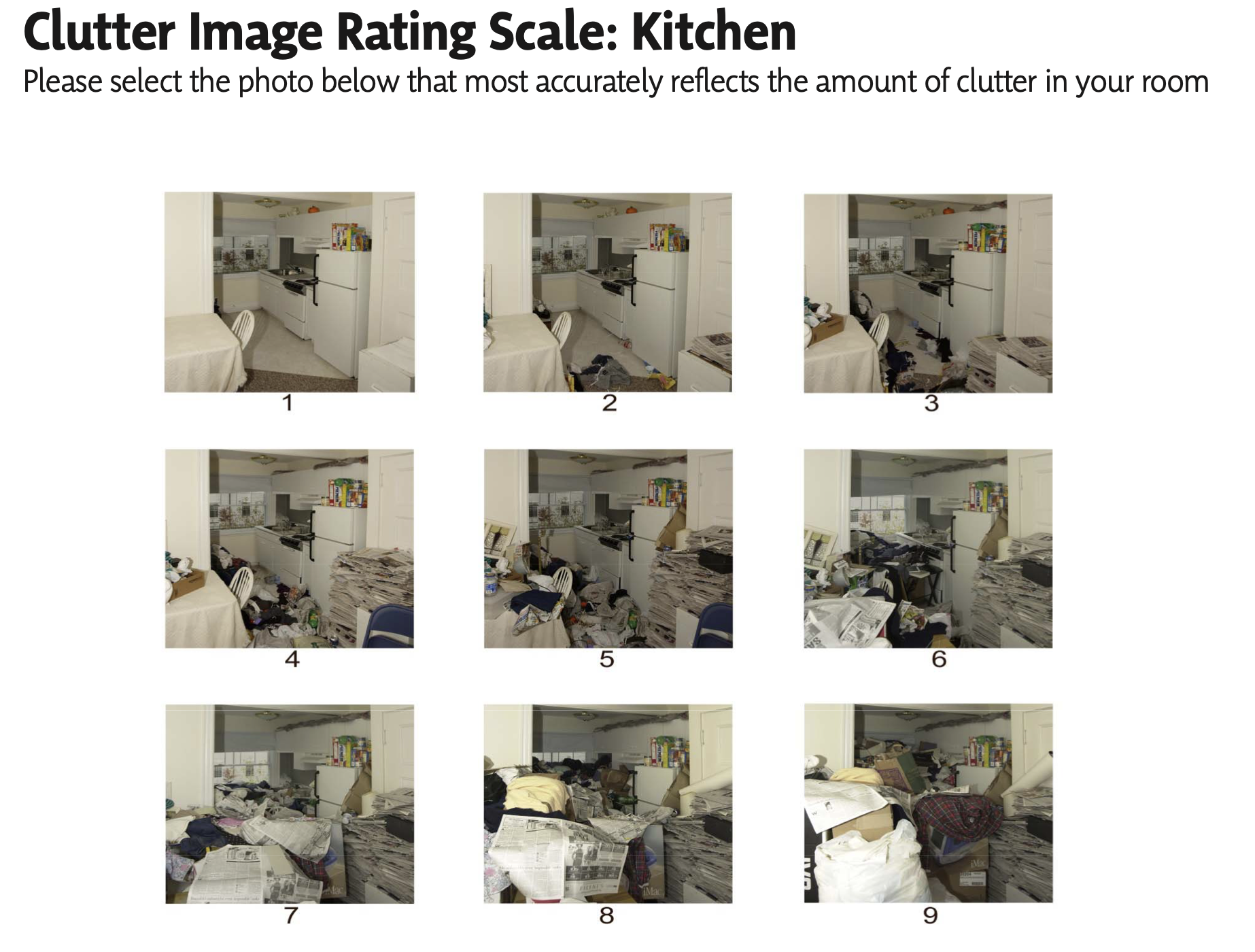
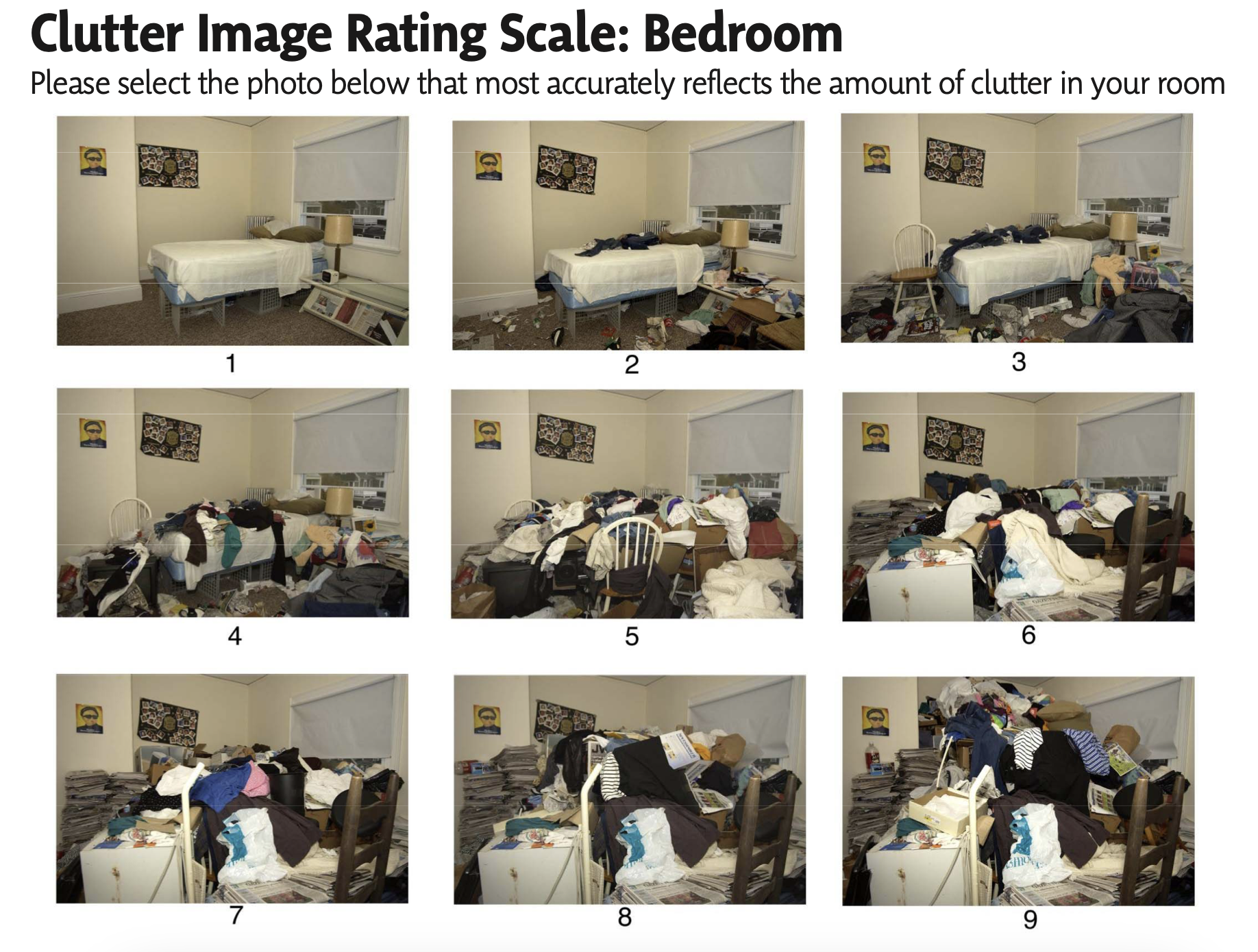
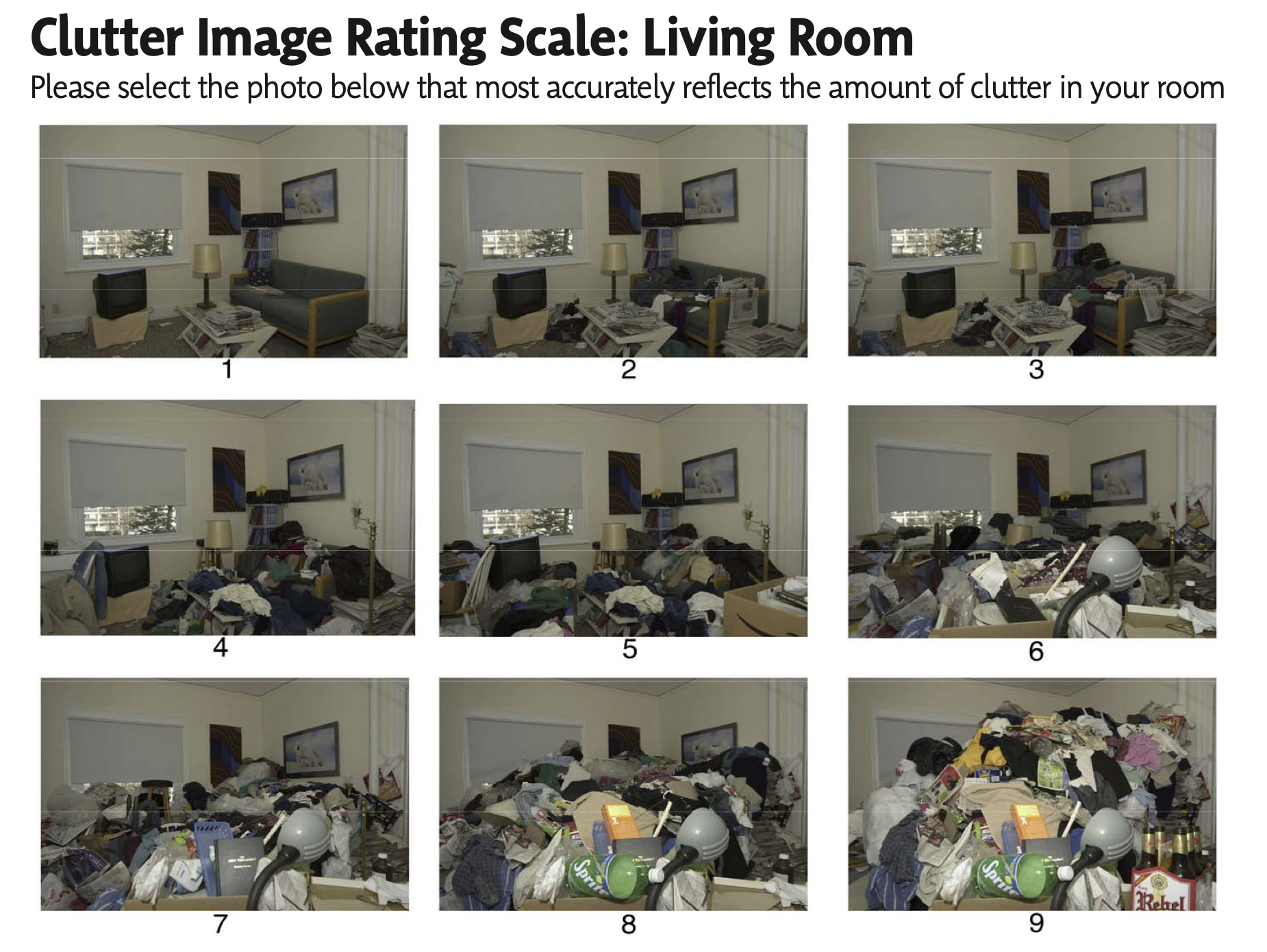
There is a quiz in the book, Buried in Treasures, which you can take to see if you fall into that category. The book is widely available through your local library. For a quick visual test, you can use the Clutter Image Rating Scale. You simply select whichever picture looks closest to your space. This test was developed by experts in the field, Frost, Steketee, Tolin, and Renaud in 2008 and research has been completed verifying that is a useful measuring tool.
As you can see, there are varying levels of hoarding. While you may not be at a 9, it can become concerning when it is difficult to use things as intended, and safety becomes an issue. For example, at levels 4 and 5 in the bedroom, it is unlikely that you would be able to sleep on the bed anymore. Similarly, at a level 4 or 5 in the living room, tripping and falling would be a concern; getting out safely if there was an emergency, or paramedics coming in to help you if needed, would be a challenge. Sometimes there are housing issues which can be extremely difficult to overcome as well at a level 5, such as a mouse, fruit fly or other pest infestation, or a problem such as a water leak or needing to get to the furnace to work on it. If it is too difficult, then these problems can fester and become worse over time and make a housing situation unsafe to live in. You can imagine water damage that isn’t addressed completely, which results in mold developing and getting into books and papers that a person was keeping. That would not be good for someone to breathe in day after day.
I believe my loved one has a hoarding disorder. What should I do?
It is very common for family and friends to be ready to take action long before a person who is struggling with a hoarding disorder. Even if they are frustrated themselves, the discomfort of getting rid of items is so great they often will not act. The best help you can provide is to be supportive and understanding. Shame, blame, and anger will not help. People do not change when they feel bad. Often, hoarding issues have gone on for many years, and it is extremely difficult not to feel frustrated with your loved one. This is very common and normal. They may promise to take some action or do things differently, and they have not followed through in the past, so you do not believe them. This is part of why it can be extremely helpful to bring in a neutral third party, such as a professional organizer, to help in this situation. People change when they feel seen, heard, validated, and supported. That is our approach and goal when we work with clients.
There are so many more facets that I could write about hoarding disorder and people who are hoarding, but that will have to go into another blog post. Please reach out directly if you have questions or want to talk through a situation. I would love to help!
